Make It Your Own: The West Wing Balcony
Here's something I think about a lot: every director brings a different vision to a show. Two productions of Beauty and the Beast staged in the same year, in different schools, in different cities, will have completely different interpretations, different emphases, different emotional beats, different ideas about what the story is ultimately about. That's what makes theatre alive.
So when I design a scene, I try not to impose a single interpretation. I try to give directors options.
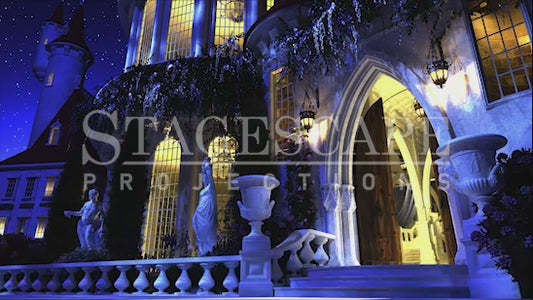
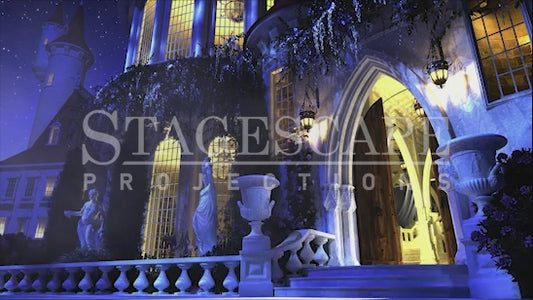
The West Wing Balcony scene ends Act 1, and it's a moment that carries real dramatic weight. My original design for this scene ends in a way that reflects the Beast's emotional state, clouds drift across and obscure the moon, the scene darkens, and snow begins to fall. It's melancholic. Unresolved. The curtain comes down on something heavy and uncertain.
But that's my reading of the moment. Yours might be different.
Maybe you want Act 1 to end on something more hopeful, a hint that things are beginning to shift, even if the Beast can't see it yet. A soft sunrise bleeding into the scene, gentle and quiet, suggesting possibility rather than despair.
That state is already in the package. It's sitting there in the candy bag, ready to use. You don't need to commission anything new or make do with something that doesn't quite fit your vision. You simply choose the ending that serves your production, and build your Act 1 curtain around it.
This is what multiple lighting states make possible: not just emotional transitions within a scene, but genuine creative ownership of the material. The design is a starting point, not a prescription.
A Change in Me: When Subtle Is Everything
Not every lighting state shift needs to be dramatic to be effective. Sometimes the most powerful thing you can do is almost nothing, and trust the audience to feel it anyway.
A Change in Me is one of Belle's most intimate moments in Beauty and the Beast. It's a quiet, inward song, a character realising something has shifted inside her, even if she can't fully articulate what. The final chorus is the emotional peak: the moment the realisation lands, and Belle steps fully into who she's becoming.
For that moment, I designed an alternate lighting state that is, on the surface, almost identical to what came before it. The scene is the same. The light source is the same. But as Belle reaches that final chorus, a teal deckle gobo wash gently rotates across the scene, soft, barely-there, a shimmer of movement and colour that wasn't present before.
It's not a dramatic shift. It doesn't pull focus from the performer. But it does something that I find remarkable every time I see it work: it makes the audience feel that something has changed, even before they consciously register why.
That's the power of a well-timed subtle state. It's not about the visual being noticed. It's about the visual supporting the emotional arc so seamlessly that the audience simply feels moved and attributes it entirely to the performance, which is exactly where the credit belongs.
The projection's job, in moments like this, is to be invisible. To support without announcing itself. A rotating gobo wash that nobody in the audience could name, but that everyone in the room feels.
Be Our Guest: Seven Minutes, Multiple Worlds
A different kind of challenge: Be Our Guest runs for almost seven minutes. It's not one song so much as a theatrical event - a sequence of distinct sections, each with its own musical style, energy, and choreographic character. The number moves through different styles and feels, each shift marked by the music and the performance.
Each of those shifts deserves its own visual moment. Our states for this scene are designed to track exactly those musical and choreographic transitions, so as the number moves, the projection moves with it. The result is a visual experience that feels alive and intentional, not a static backdrop that the cast happens to be performing in front of.
The Moment That Confirmed Everything
I had a client purchase our Beauty and the Beast Deluxe package for their production. After the run, they came back to me with feedback that I think about often.
They told me that during tech week, they discovered they needed a shift in a scene they hadn't planned to change. Something about seeing the scene in the space, with the performers, under the stage lights, made it clear that a transition was needed. A moment that hadn't looked significant on paper became, in that environment, something that needed to breathe and change.
Because we include a minimum of five states with every scene, the solution was already sitting in their download folder. They found the state they needed, cued it at the right moment, and what had been a potential problem became something that looked entirely planned.
They described it as having a "candy bag" of options to reach into. That phrase has stuck with me, because it captures something important: theatre is unpredictable. Tech week has a way of revealing things you didn't see coming. Having more than you need isn't wasteful - it's smart.

What This Means in Practice
Using multiple lighting states isn't complicated. In QLab or most playback software, you're simply cueing a different file at the right moment - the same way you'd cue a lighting change or a sound effect. The complexity is built into the design work, not the operation.
What it gives a production is real creative control. The ability to make the visual world of your show respond to the story the way your lighting already does. The ability to give key moments - romantic, comedic, dramatic - the visual environment they actually deserve, not just the one that was set when the scene opened.
It's a simple idea, honestly. I'm surprised it's not standard practice. But when you see what it does on stage - when you watch an audience respond to a projection that's actively participating in the storytelling rather than sitting quietly in the background - it's difficult to go back.
See It For Yourself
Every scene in the StageScape Projections library comes with a minimum of five lighting states. If you'd like to explore what that looks like across our full range of scenes and shows, the entire library is available to browse.
Explore the full StageScape Projections library
If you have questions about how lighting states work in practice, or want to talk through how they might work for your specific production, I offer free 30-minute design consultations - just get in touch.
You May Like...
-
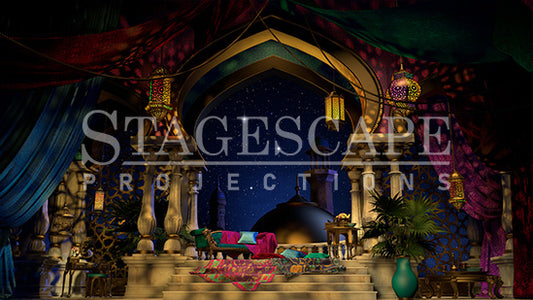
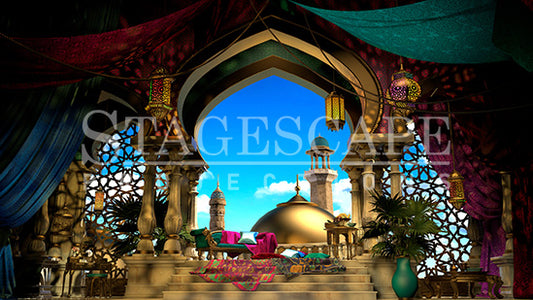
Arabian Princess Room | Static
Regular price From $120.00 AUDRegular priceUnit price per -
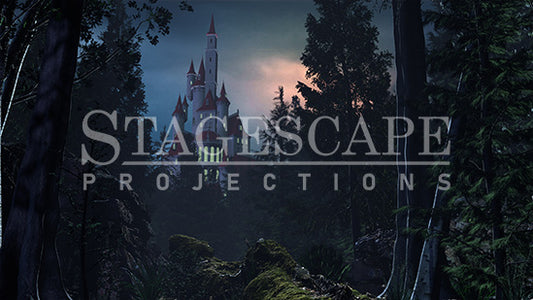
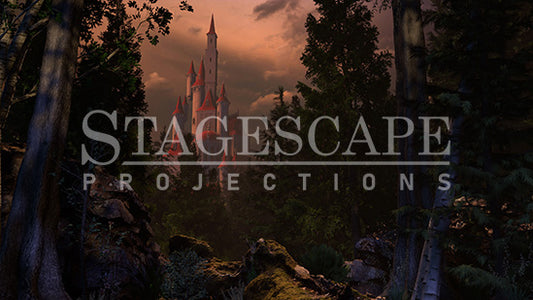
Castle Beyond the Forest | Static
Regular price From $171.00 AUDRegular priceUnit price per -
Castle Dungeon | Static
Regular price From $120.00 AUDRegular priceUnit price per -
Castle Exterior | Animated
Regular price From $200.00 AUDRegular priceUnit price per