

Why Do I Design Every Scene Five Times?
There's a decision I made early on when building StageScape Projections that costs me a significant amount of extra time with every single scene I create. Instead of designing one beautiful image and moving on, I design five.
Five different lighting states. Five different moods. Five different versions of the same physical location.
It would be far easier, and far faster, to produce one polished scene and move straight to the next. My library would grow at a much quicker rate. But I don't do that. And every time I see the difference it makes on stage, I'm reminded exactly why.

That First Moment the Lights Come Up
When a scene opens and the projection hits the cyclorama for the first time, something extraordinary happens in those first three seconds. The audience absorbs an enormous amount of information almost unconsciously, the composition, the colour temperature, the depth of the shadows, the quality of the light. None of this is consciously processed. They're watching your performers, following the story. But all of it is being absorbed.
That establishing image isn't just telling the audience where they are. It's telling them how to feel.
This is why I obsess over every lighting decision in every scene I design. The direction of the light source, the warmth or coolness of the palette, the depth of the shadows in the corners, the way a practical light, a candle, a lantern, a fireplace, throws colour across the environment. These choices aren't decoration. They're storytelling.
And if that initial image is doing all of that emotional work in three seconds imagine what a deliberate change to that image can do mid-scene.

The Shift
Here's what I've come to understand about theatre: almost every scene contains a shift. An emotional turn between two characters. A plot revelation. A tonal change as a song builds or resolves. A moment when the world of the story tilts slightly on its axis.
In traditional theatre, lighting has always responded to these shifts. A subtle colour change on the cyc. A dimming of the fill as the scene darkens emotionally. A warm wash that cools as a relationship fractures. Lighting Designers understand instinctively that light follows story.
But here's what's always struck me as an odd blind spot: when productions use projection, the backdrop almost universally stays the same for the entire scene. The stage lighting shifts and responds and breathes but the projection just sits there, static and unchanging, while the story moves around it.
I've spent years working in set design, and one of the things that never stops exciting me is that moment after a bump-in when you finally sit down for the lighting plot. The set is built, the space is ready, and then the lighting designer begins their work and something almost magical happens. A set you've working on for months suddenly becomes something else entirely. Shadows fall in unexpected places. Colour transforms the mood. The whole environment shifts and breathes and comes alive in ways that no amount of planning fully prepares you for. Even after all this time, it gets me every single time.
That transformation, a physical set looking completely different simply because of how it's lit, is one of theatre's quiet miracles. So why shouldn't our projections offer that same experience? That same magic. That same flexibility to evolve with the mood of the scene, to respond to the story, to feel alive rather than fixed.
Why are we not giving our digital projection the same attention we give our lighting?
At StageScape Projections, that's exactly what we do.
Each scene in our library comes with a minimum of five lighting states, the original scene, plus four carefully considered alternates. Each state presents the same physical location, but with a meaningfully different mood, time of day, or emotional tone. Sometimes the difference between states is dramatic. Sometimes it's remarkably subtle. But even subtle changes, cued at exactly the right moment, can be surprisingly powerful on stage.

The Cursed Garden: A Scene That Has to Do Two Things
Let me give you a concrete example, because this is where the idea stops being theoretical and becomes something you can actually see.
Our Cursed Garden Vista was designed for Beauty and the Beast. It's one of the most emotionally demanding scenes in the show - a magical, star-filled sky overlooking an enchanted garden. The scene carries two completely different emotional weights within the same setting.
First, it's deeply romantic. This is the moment the Beast truly falls in love with Belle, the scene breathes with possibility and warmth. The stars are out, the garden glows with a soft magical light, and for a moment it feels like the curse might actually be broken.
Then Belle leaves.
And the Beast is alone. Knowing that the curse will never be broken. That he will remain the Beast forever.
Those are not the same emotional world. They cannot be served by the same image.
So the scene transitions across its lighting states: the warmth of the romantic opening gradually gives way as stars begin to disappear. Fog sinks slowly into the garden. The lantern lights extinguish, until the Beast stands in a misted, haunted, darkened space - truly alone.
That transition is achieved entirely through the lighting states built into the scene. No new backdrop. No technical complication. Just a director choosing the right state at the right moment, and the projection doing exactly what the story needs.
Without those alternate states, the scene would be the same image from curtain to curtain. The lighting and performance would still carry the emotion, but the visual world would be working against you instead of with you.

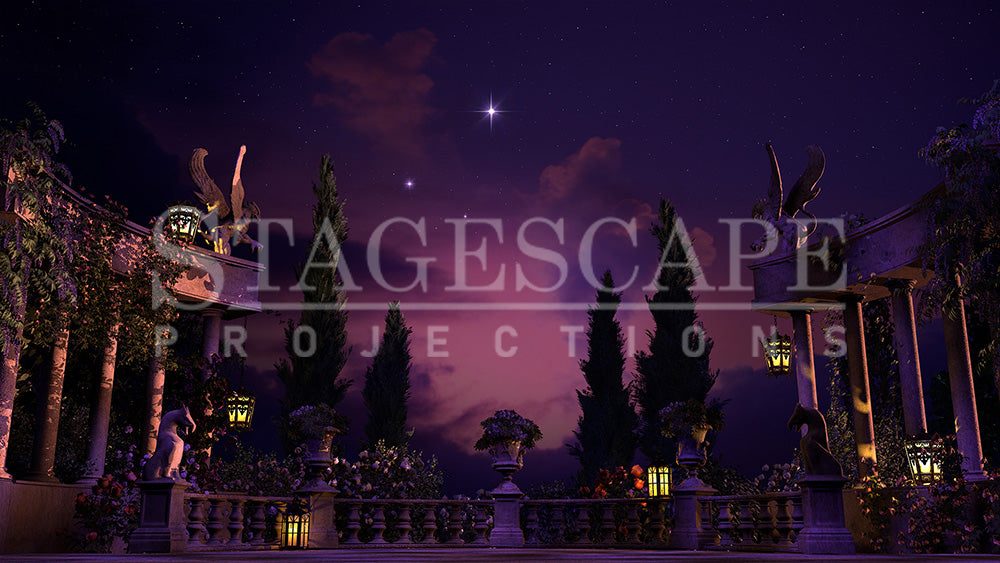

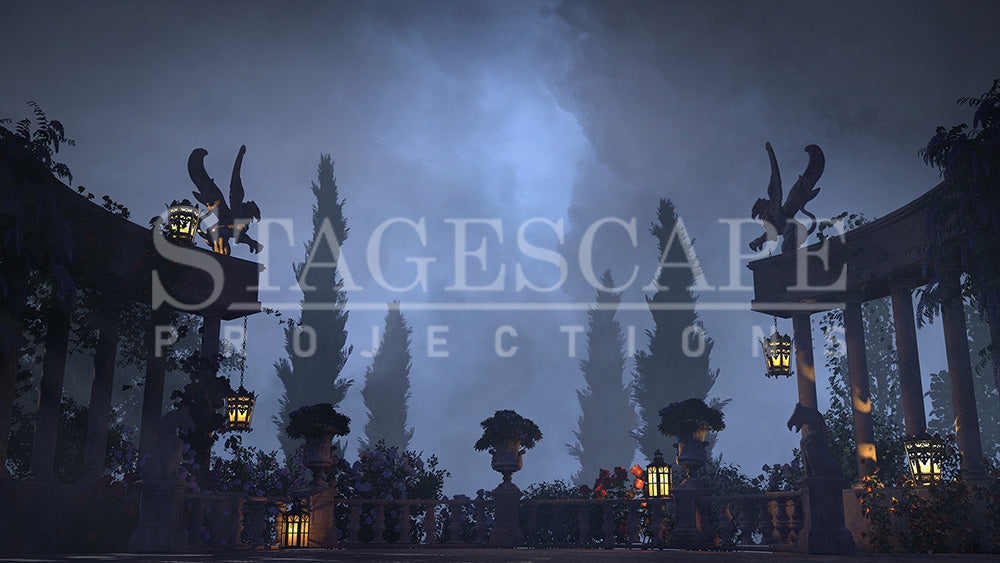
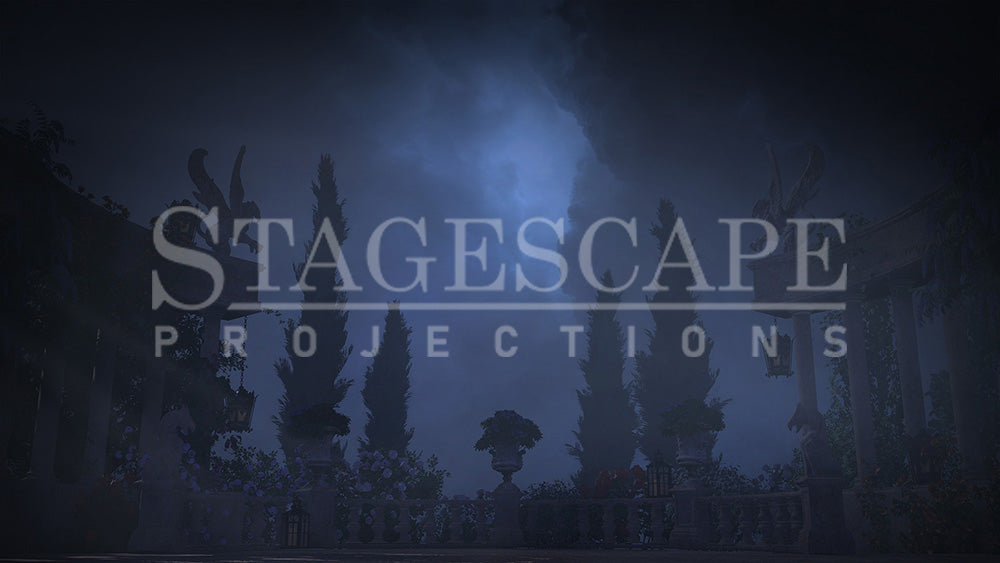
◀ Slide to explore lighting states ▶
Make It Your Own: The West Wing Balcony
Here's something I think about a lot: every director brings a different vision to a show. Two productions of Beauty and the Beast staged in the same year, in different schools, in different cities, will have completely different interpretations, different emphases, different emotional beats, different ideas about what the story is ultimately about. That's what makes theatre alive.
So when I design a scene, I try not to impose a single interpretation. I try to give directors options.
The West Wing Balcony scene ends Act 1, and it's a moment that carries real dramatic weight. My original design for this scene ends in a way that reflects the Beast's emotional state, clouds drift across and obscure the moon, the scene darkens, and snow begins to fall. It's melancholic. Unresolved. The curtain comes down on something heavy and uncertain.
But that's my reading of the moment. Yours might be different.
Maybe you want Act 1 to end on something more hopeful, a hint that things are beginning to shift, even if the Beast can't see it yet. A soft sunrise bleeding into the scene, gentle and quiet, suggesting possibility rather than despair.
That state is already in the package. It's sitting there in the candy bag, ready to use. You don't need to commission anything new or make do with something that doesn't quite fit your vision. You simply choose the ending that serves your production, and build your Act 1 curtain around it.
This is what multiple lighting states make possible: not just emotional transitions within a scene, but genuine creative ownership of the material. The design is a starting point, not a prescription.
A Change in Me: When Subtle Is Everything
Not every lighting state shift needs to be dramatic to be effective. Sometimes the most powerful thing you can do is almost nothing, and trust the audience to feel it anyway.
A Change in Me is one of Belle's most intimate moments in Beauty and the Beast. It's a quiet, inward song, a character realising something has shifted inside her, even if she can't fully articulate what. The final chorus is the emotional peak: the moment the realisation lands, and Belle steps fully into who she's becoming.
For that moment, I designed an alternate lighting state that is, on the surface, almost identical to what came before it. The scene is the same. The light source is the same. But as Belle reaches that final chorus, a teal deckle gobo wash gently rotates across the scene, soft, barely-there, a shimmer of movement and colour that wasn't present before.
It's not a dramatic shift. It doesn't pull focus from the performer. But it does something that I find remarkable every time I see it work: it makes the audience feel that something has changed, even before they consciously register why.
That's the power of a well-timed subtle state. It's not about the visual being noticed. It's about the visual supporting the emotional arc so seamlessly that the audience simply feels moved and attributes it entirely to the performance, which is exactly where the credit belongs.
The projection's job, in moments like this, is to be invisible. To support without announcing itself. A rotating gobo wash that nobody in the audience could name, but that everyone in the room feels.
Be Our Guest: Seven Minutes, Multiple Worlds
A different kind of challenge: Be Our Guest runs for almost seven minutes. It's not one song so much as a theatrical event - a sequence of distinct sections, each with its own musical style, energy, and choreographic character. The number moves through different styles and feels, each shift marked by the music and the performance.
Each of those shifts deserves its own visual moment. Our states for this scene are designed to track exactly those musical and choreographic transitions, so as the number moves, the projection moves with it. The result is a visual experience that feels alive and intentional, not a static backdrop that the cast happens to be performing in front of.
The Moment That Confirmed Everything
I had a client purchase our Beauty and the Beast Deluxe package for their production. After the run, they came back to me with feedback that I think about often.
They told me that during tech week, they discovered they needed a shift in a scene they hadn't planned to change. Something about seeing the scene in the space, with the performers, under the stage lights, made it clear that a transition was needed. A moment that hadn't looked significant on paper became, in that environment, something that needed to breathe and change.
Because we include a minimum of five states with every scene, the solution was already sitting in their download folder. They found the state they needed, cued it at the right moment, and what had been a potential problem became something that looked entirely planned.
They described it as having a "candy bag" of options to reach into. That phrase has stuck with me, because it captures something important: theatre is unpredictable. Tech week has a way of revealing things you didn't see coming. Having more than you need isn't wasteful - it's smart.

What This Means in Practice
Using multiple lighting states isn't complicated. In QLab or most playback software, you're simply cueing a different file at the right moment - the same way you'd cue a lighting change or a sound effect. The complexity is built into the design work, not the operation.
What it gives a production is real creative control. The ability to make the visual world of your show respond to the story the way your lighting already does. The ability to give key moments - romantic, comedic, dramatic - the visual environment they actually deserve, not just the one that was set when the scene opened.
It's a simple idea, honestly. I'm surprised it's not standard practice. But when you see what it does on stage - when you watch an audience respond to a projection that's actively participating in the storytelling rather than sitting quietly in the background - it's difficult to go back.
See It For Yourself
Every scene in the StageScape Projections library comes with a minimum of five lighting states. If you'd like to explore what that looks like across our full range of scenes and shows, the entire library is available to browse.
Explore the full StageScape Projections library
If you have questions about how lighting states work in practice, or want to talk through how they might work for your specific production, I offer free 30-minute design consultations - just get in touch.
Blog posts
View all-

Into the Dark: The Design Philosophy Behind Our Wizard of Oz
There is a design problem unique to The Wizard of Oz that I don't think exists in any other show in the StageScape library. Almost nobody in the auditorium will...
Into the Dark: The Design Philosophy Behind Our Wizard of Oz
There is a design problem unique to The Wizard of Oz that I don't think exists in any other show in the StageScape library. Almost nobody in the auditorium will...
-

The Floating Clouds Problem
Just because you can animate every scene doesn't mean you should. A recent production reminded me why restraint is the most underrated tool in projection design.
The Floating Clouds Problem
Just because you can animate every scene doesn't mean you should. A recent production reminded me why restraint is the most underrated tool in projection design.
-

No Fly Tower, No Wing Space: How to Stage a Big School Musical Anyway
You've committed to the show. Now you're staring at a stage with a ceiling too low to fly anything and wings barely wide enough for a costume rack, wondering how...
No Fly Tower, No Wing Space: How to Stage a Big School Musical Anyway
You've committed to the show. Now you're staring at a stage with a ceiling too low to fly anything and wings barely wide enough for a costume rack, wondering how...


